By Frolsket Editorial Team (Business technology editorial team) · Published · Updated · 5 min read · Products
Designing a Purchase Approval Workflow That People Can Follow
Map purchase requests, approval limits, exceptions, and handoffs before configuring a business software workflow.
Begin with the decision, not the form
A purchase approval workflow should help a business decide whether to commit money, who may make that decision, and what should happen next. A digital form alone does not answer those questions. If staff cannot tell which purchases need approval or where a request has stalled, they may resort to private messages and make the system's records incomplete.
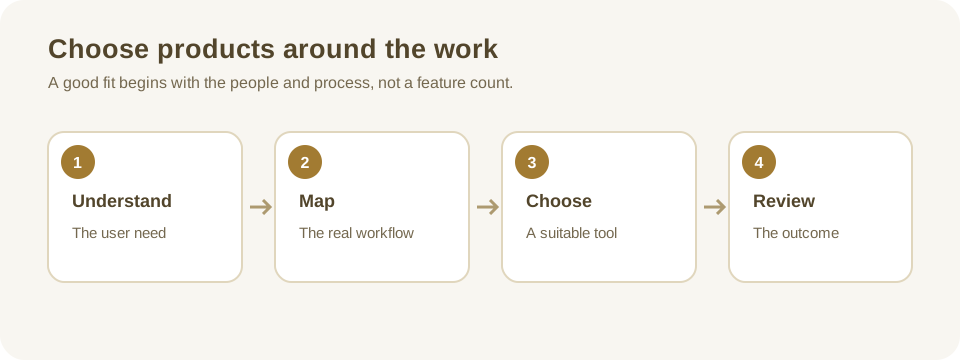
Start with one common purchase, such as replacing a damaged laptop or ordering routine office supplies. Follow the request from the person identifying the need through approval, ordering, receipt, and invoice review. Ask the people performing each step to describe what they need from the previous person. Include the steps currently handled by email or spreadsheets, because those workarounds often reveal gaps in the formal process.
The purpose is not to add a checkpoint to every purchase. It is to match oversight to risk while making responsibility visible. A small routine purchase and an expensive recurring contract may need different paths. Document the reason for each difference before configuring software.
Define what a complete request contains
A useful request explains the item or service, business purpose, estimated total, needed-by date, and requester. Depending on the business, it may also identify a cost centre, delivery location, proposed supplier, and supporting quote. Explain whether the estimate includes tax, shipping, subscriptions, or other recurring costs. An approval based on an incomplete total can create an unpleasant surprise later.
Do not require every detail at the first step if the requester cannot reasonably know it. A facilities employee may know that a printer needs repair without knowing which vendor should perform the work. Allow the purchasing team to add supplier information during review, and distinguish fields needed to submit a request from those needed to place an order.
Example: an urgent replacement
Suppose a team's only label printer fails during a busy dispatch period. The requester records the operational impact, an estimated cost, and the date a replacement is needed. A manager can approve the need while procurement confirms availability and the final price. If the confirmed price exceeds the permitted range, the request returns for the appropriate approval instead of quietly becoming a larger commitment.
Establish approval authority and boundaries
Write approval rules in language staff can understand. Identify the responsible role, applicable spending limit, and any additional review needed for contracts, sensitive data, or unusual suppliers. Decide whether limits apply to an individual request, a whole order, or a recurring commitment over a defined period. Have the relevant finance and management teams approve the rules; software configuration should reflect organizational policy rather than invent it.
Consider who can approve a request when the usual approver is unavailable. A named delegate with a defined period of authority is safer than sharing a login or asking an unrelated colleague to approve. Also decide what happens when the requester is normally the approver. A separate reviewer may be appropriate, but the exact rule depends on the organization's size and controls.
Record a decision as approved, rejected, or returned for more information, with a reason where needed. A returned request is not the same as a rejection. The requester should see what information is missing and be able to resubmit without losing the history of the original request.
Plan the transition from approval to ordering
Approval to buy is not proof that an order was placed. Give the purchasing owner a clear next action and record the order reference when available. If the supplier changes the price, delivery date, or scope, define when a new review is required. A system can notify an owner about an approved request, but the business still needs a way to see whether the owner accepted and completed the task.
Receiving should also be distinct from ordering. For physical goods, record what arrived and any shortage or damage. For a service, agree who confirms completion and what evidence is sufficient. When an invoice arrives, the reviewer can compare it with the approved request, order, and receipt information as applicable. This comparison should follow the organization's financial procedures and is not a substitute for professional accounting advice.
Test exceptions before launching
Use a small set of realistic scenarios when reviewing software. Test a request below an approval limit, one above it, one returned for missing details, and one that changes after approval. Include an absent approver and a request that needs to be cancelled. Confirm who can view supplier quotes and financial details, and check that access changes when a person changes roles.
Ask how the proposed tool handles failed notifications, duplicate requests, and corrections to an approved record. A request appearing in a dashboard is not proof that an email was delivered or that a responsible person saw it. Decide how unresolved requests are found and escalated. Use synthetic data for demonstrations, especially when real supplier pricing or personal information is sensitive.
Review the history, not just the current status
Open a completed test request and trace who submitted it, what changed, who approved it, and whether an order followed. Check whether a correction preserves the earlier decision and whether the history is understandable to an authorized reviewer. Confirm retention and export requirements with the people responsible for records rather than assuming every product stores the same evidence.
Pilot, measure, and improve
Pilot the workflow with a small group and a limited type of purchase. Measure the time spent waiting for information, the number of requests returned for clarification, and the proportion that reach an owner after approval. Interpret these measures alongside feedback: a longer review may be appropriate for a complex contract, while a quick approval may still be incomplete.
After the pilot, adjust unclear labels and remove fields that nobody uses. Assign an owner to review approval limits, delegates, and exceptions as the business changes. For a broader approach to evaluating tools, see the business software selection guide . A dependable workflow makes decisions and handoffs clear; it does not depend on people remembering an undocumented series of clicks.
Continue your research
Explore related products articles for other perspectives and practical examples. For a business-specific question, contact Frolsket to clarify the relevant scope rather than treating general editorial guidance as a product commitment.