By Frolsket Editorial Team (Business technology editorial team) · Published · Updated · 5 min read · Products
Planning a Business Software Pilot Around Real Work
Set a practical pilot scope, test ordinary and exceptional work, and decide what evidence is needed before a wider rollout.
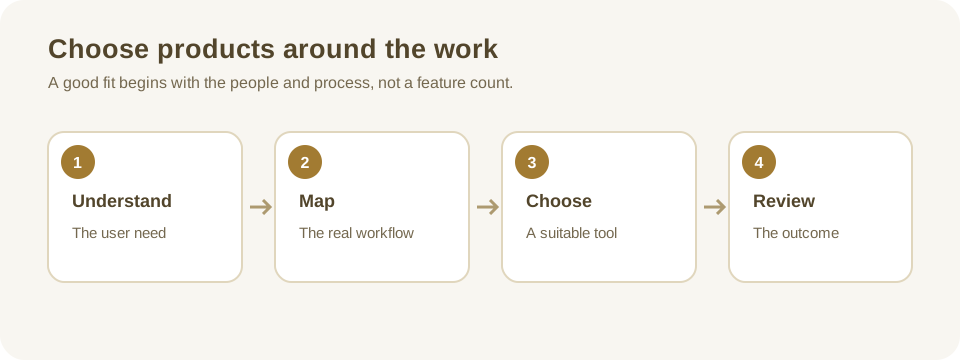
Give the pilot a decision to support
A software pilot is a limited trial designed to answer a specific question. It is not simply a demonstration with more users, and it should not become an unofficial permanent system because nobody defined an end date. Before inviting participants, write down the decision the pilot will inform: for example, whether a proposed application can support a team's service-request process without losing ownership or customer context.
Name the decision owner and agree when the results will be reviewed. Identify the people who will perform the work, the people who receive its outputs, and anyone responsible for access, privacy, or support. Ask them what would make the trial useful and what would make it unsafe or disruptive. A short written charter can capture the scope, participants, dates, risks, and intended outcome without becoming a large project document.
The business software selection guide describes a broader evaluation process. The pilot turns a few important questions from that process into observable examples. Avoid trying to validate every feature at once: an overly broad trial can consume time while leaving the central decision unclear.
Choose a workflow with a clear boundary
Select one real workflow with a recognizable beginning and end. A service team might receive a request, identify an owner, investigate, communicate an update, and record a resolution. Define which request types are included and which remain in the existing process. If customer communications or financial commitments are involved, decide whether the pilot uses synthetic examples, historical copies, or live work with suitable controls.
Map the handoffs as well as the screens. A request that moves smoothly for its original owner may still fail when that person is absent or another team must contribute. Write down what information the next person needs, when responsibility changes, and how the requester receives an update. These observations help distinguish a software limitation from an unclear process that would persist in any tool.
Example: a small support team
Imagine a team handling facilities requests across two offices. Its pilot covers routine equipment issues for one office, not emergencies or building access incidents. Participants create sample requests, assign owners, record updates, and close completed work. The group also tests what happens when a request belongs to the wrong team. The limited scope makes it possible to review the full journey without exposing every office to an unfinished process.
Agree on evidence before collecting it
Define a few measures linked to the decision. For the facilities example, useful evidence might include whether every request has a visible owner, how often a requester needs to repeat information, and how long items wait without an update. Record the starting conditions and explain how measurements will be collected. A pilot with ten unusual cases should not be presented as a precise forecast of performance across the whole organization.
Include qualitative feedback. Ask participants which steps were confusing, what work they performed outside the system, and whether they could find the information needed for a decision. A short observation session can reveal a problem that a satisfaction score misses. Avoid using pilot results as an employee performance ranking; people need to report friction honestly for the trial to improve the process.
Define success and stop conditions before the trial. A stop condition might be an unauthorized disclosure, loss of a record, or an inability to perform a critical action safely. An issue may also require a pause while the owner investigates. Decide who can make that call and how participants return to the existing process.
Prepare access, data, and support
List the roles needed for the pilot and grant only the access each role requires. Use test accounts and synthetic records where possible. If real data is necessary, agree on the legal and organizational basis for its use, the data shared with the provider, retention, and deletion. Do not copy an entire customer database into a trial merely because importing it is convenient.
Explain where users should report a problem and what information to include. Provide a named support contact, a way to record incidents, and a response expectation suitable for the trial. Confirm what happens if the application is unavailable. Participants should know whether to stop, use a temporary alternative, or continue in the existing system. Avoid promising a support level that the provider has not agreed to deliver.
Check export and exit arrangements before entering important data. A successful pilot should not depend on a vendor being the only party able to retrieve the trial records. Ask which formats are available, what happens to attachments and history, and who will confirm deletion when the trial ends.
Exercise ordinary work and exceptions
Prepare a short scenario list with expected outcomes. Include a straightforward case, an incomplete request, a duplicate, a reassignment, a cancellation, and a correction after closure where relevant. Check permissions by attempting an action with an account that should not be authorized. Record actual behavior and the conditions under which it occurred rather than marking a feature as passed because it appeared in a menu.
Follow a request through a change
During the facilities pilot, assign a request to one coordinator and then simulate that person going on leave. Confirm that another authorized person can identify the outstanding work and take responsibility without losing the earlier notes. Send an update to the requester through the agreed channel. If an automated notice fails, verify that the team has a visible recovery step rather than assuming the notice was received.
Some gaps can be resolved through configuration or training; others need product changes, additional cost, or a change to the workflow. Record those distinctions. Ask the provider to confirm which behavior is included in the proposed agreement and which requires separate work.
Make a decision and close the trial
At the end, compare the evidence with the original decision criteria. Summarize what worked, unresolved risks, participant feedback, support needs, and expected implementation work. The decision might be to proceed, extend the pilot with a specific question, select a different approach, or stop. Avoid a vague conclusion such as “users liked it” when the organization needs to know whether the workflow is reliable and supportable.
If the organization proceeds, assign owners for migration, training, access, and operational support before expanding. If it stops, export or remove trial records according to the agreed plan and tell participants where their work continues. A useful pilot creates clarity even when the answer is no: it replaces assumptions with evidence about real work and a documented next step.
Continue your research
Explore related products articles for other perspectives and practical examples. For a business-specific question, contact Frolsket to clarify the relevant scope rather than treating general editorial guidance as a product commitment.